
RoadBuddy provides independent information to help drivers compare auto insurance options with confidence. We may earn a commission when you click on partner links, but this never affects our reviews or recommendations. Our content is researched and published independently.
Advertiser Disclosure
RoadBuddy is a free resource that helps drivers compare auto insurance options.
We may receive compensation from some insurance companies and partners when you click on links or request a quote through our site. This may affect where offers appear, but it does not influence our reviews, guidance, or editorial decisions.
Our content is researched and written independently to give you clear and unbiased information.
By using RoadBuddy, you acknowledge and accept this disclosure. Learn more.
The term “full coverage” is used quite commonly when people discuss insurance for their cars. The problem is that this term is not actually considered an insurance term. In fact, there is no policy that is actually considered “full coverage” that one can purchase. “Full coverage” is simply a term that means that a person has different types of insurance that can cover the majority of the different situations that they may find themselves in.
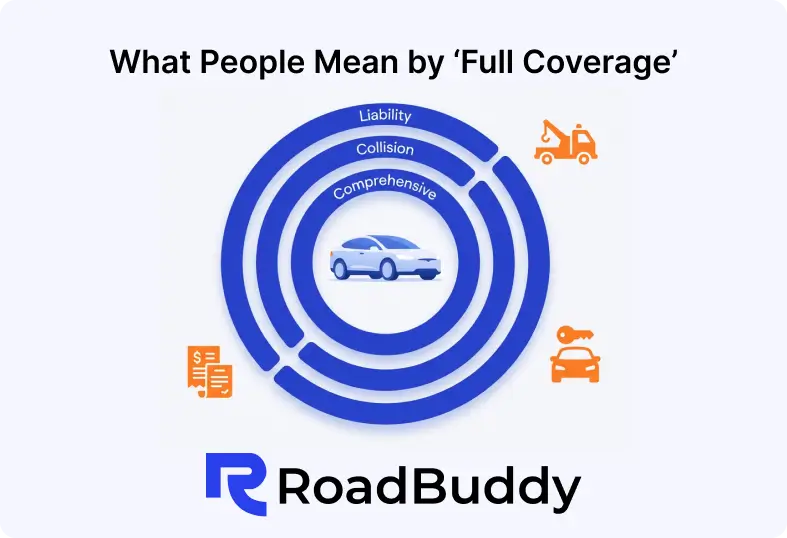
When a person tells you that they have “full coverage,” they probably mean that they have liability insurance, which is actually needed in most states, as well as collision and comprehensive insurance for their vehicle. There are also a few other types of insurance that they may mean, depending on the state that they are living in.
It is also important to know what is actually included in “full coverage” since the name of the policy may actually lead a person to believe that they are actually covered, even though this may not be the case.
What Full Coverage Typically Includes
In most cases, when insurance companies or lenders refer to full coverage, they are referring to these basic elements combined.
Liability Coverage
All states require you to carry some form of liability coverage. This coverage is there to protect everyone else in case you’re the one who causes the accident. You’ve got two important ones: bodily injury liability pays for the doctor visits, time off work, and lawyer fees for everyone you can hurt with your driving; property damage liability pays for repairs to their ride.
But don’t expect this insurance to cover your own damages, or repairs to your ride, even if you’re the one who caused the accident.
Collision Coverage
This kicks in when your car is damaged as a result of an accident with another car or an object. This includes instances such as hitting another car, hitting a pole when reversing, or when the car hits a guard rail as a result of sliding, irrespective of who is at fault.
Collision coverage has a deductible as well. A deductible is the amount that is paid out of pocket before the rest is paid by the insurance company. For example, if the deductible is $500 and the cost of repairs is $3,000, you pay the deductible, and the rest is paid by the insurance company.
Comprehensive Coverage
Comprehensive coverage protects against damage that is not due to a collision. Comprehensive covers damage that is out of your hands. For example, theft, vandalism, fire, flood, hail, hitting a deer, or if a tree falls on your car when it is parked are all comprehensive claims.
Just like collision coverage, comprehensive also comes with a deductible. For example, if your hailstorm damage is estimated at $2,000 and your deductible is $500, you pay the deductible and the insurance company pays the rest.
Collision and comprehensive together are sometimes called “physical damage coverage” because they both protect your actual vehicle, just in different scenarios.

Make Sure You’re Not Overpaying
You’ll be redirected to our partner’s site to get offers.
Advertiser Disclosure
RoadBuddy is a free resource that helps drivers compare auto insurance options.
We may receive compensation from some insurance companies and partners when you click on links or request a quote through our site. This may affect where offers appear, but it does not influence our reviews, guidance, or editorial decisions.
Our content is researched and written independently to give you clear and unbiased information.
By using RoadBuddy, you acknowledge and accept this disclosure. Learn more.

Other Coverage Sometimes Included
Based on your state or what you add to your policy, full coverage may also include:
Medical Payments Coverage (MedPay) will cover your and your passengers’ medical bills in case of an accident, no matter who is to blame. MedPay will pay for bills such as ambulance services, emergency room care, surgery, and X-rays.
Personal Injury Protection (PIP) is needed in some no-fault states. It extends beyond MedPay to cover not only your medical expenses but also any wages you lose if you are unable to work because of injuries.
Uninsured/Underinsured Motorist Coverage protects you against injuries caused by an uninsured or underinsured motorist. The coverage can also pay to fix your vehicle.
What Full Coverage Doesn’t Cover
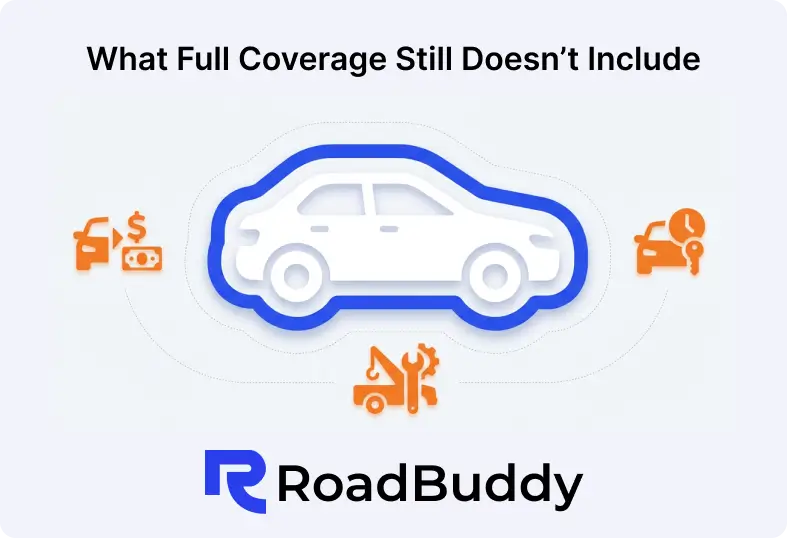
However, full coverage doesn’t cover everything. Let’s take a look at what’s not covered:
Gap insurance pays for the difference between what you owe on your car loan and what your car is actually worth if it’s totaled. This is a separate kind of coverage that’s usually required by your lender, not your insurance company.
Roadside assistance for things like car breakdowns, flat tires, lockouts, and running out of gas isn’t automatically included in your policy. This is an additional cost.
Rental car reimbursement covers the cost of renting a car while your car is in for repairs after a covered claim.
Do You Actually Need Full Coverage?
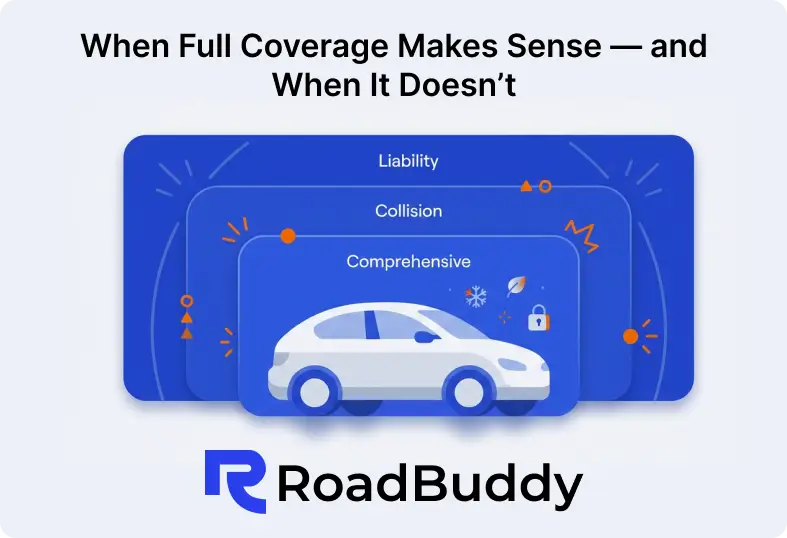
Whether or not full coverage is a good idea for you is based on a few factors that are pretty particular to your circumstances.
If you financed or leased your car,you definitely need it. This is because lenders will require you to have collision and comprehensive coverage until you pay off the loan, as they are protecting their investment. Once you own the vehicle outright, it’s up to you.
If your car is newer or worth a lot, full coverage is almost always a good idea. This is because repairs are expensive, and if your vehicle is totaled, you would have to shell out the cash out of pocket. If you couldn’t afford that in an emergency, having the coverage is a good idea to protect yourself against that risk.
If your car is older, the equation is different. A good rule of thumb is that once your vehicle reaches the age of 10, it may be worth considering whether or not collision and comprehensive coverage is worth it. If your vehicle is worth less than what you’re paying in premiums each year, plus your deductible, you may be better off dropping those two coverages and just keeping liability.
For instance, if your 12-year-old vehicle is worth about $3,000 and you pay $1,200 per year for full coverage with a $500 deductible, you are paying a lot compared to what you would actually receive if your vehicle was totaled. In such a case, many people opt to go for liability coverage and save the money for a future car purchase.
If you have solid emergency savings, you can afford to be more risky. For instance, if they can afford the cost of repairs or replacing a vehicle, they can opt out of collision and comprehensive insurance coverage to save on premiums.
However, If you don’t have savings, it is recommended that the vehicle is fully insured. The security of avoiding unexpected expenses due to vehicle damage or theft is priceless.
If you live somewhere with weather risks or high theft rates, a comprehensive insurance is valuable. Incidences such as hail storms, flooding, or hurricanes significantly increase the probability of needing to make a claim.
Make Sure You’re Not Overpaying
You’ll be redirected to our partner’s site to get offers.
Advertiser Disclosure
RoadBuddy is a free resource that helps drivers compare auto insurance options.
We may receive compensation from some insurance companies and partners when you click on links or request a quote through our site. This may affect where offers appear, but it does not influence our reviews, guidance, or editorial decisions.
Our content is researched and written independently to give you clear and unbiased information.
By using RoadBuddy, you acknowledge and accept this disclosure. Learn more.
How Much Does Full Coverage Cost Compared to Liability Only?
The difference is quite apparent. Liability only insurance costs on average $700 to $900 per year. Full coverage insurance costs on average $1,900 to $2,700 per year. This is an additional $1,200 to $1,800 per year, or $100 to $150 per month.
The prices can differ significantly depending on your area, driving record, vehicle, and insurance company. Some states also have significantly higher premiums. Young drivers or those who have had accidents will also pay more.
If you have newer or more expensive vehicles, the additional expense is well worth it since the coverage increases with your potential loss. For older vehicles with low value, it may be too much of an expense for the minimal benefit.
When People Drop Full Coverage
A lot of people cancel their collision and comprehensive coverage when their car gets to a certain age or value. The most common age is when the car is 10 years old, but it really depends on the actual value of your car and what you’re paying for coverage.
There are some insurance experts that recommend that you cancel your collision coverage if what you’re paying for coverage is more than 10 percent of your car’s actual value. For instance, if your car is worth $4,000 and you’re paying $450 a year for collision coverage, that’s more than 10 percent and might be worth canceling.
Another approach that some people take is that if two years’ worth of premiums would be enough to replace your car, then you might want to consider canceling your collision and comprehensive coverage. For instance, if you’re paying $800 a year for your collision and comprehensive coverage and your car is worth $1,600, then canceling your coverage and saving that money might be a good idea.
Of course, none of these are hard rules. Some people keep full coverage on older cars because they rely heavily on that vehicle for work or family needs and can’t afford to be without it if something happens. Others feel more comfortable taking the risk and saving the money.
Liability Coverage Stays Important No Matter What
Even if you choose to cancel the collision and comprehensive coverages, do not cancel the liability coverage. This is required by law in most states, but more important is the fact that it will protect you financially in the event of an accident where someone is injured or their property is damaged.
Not having enough liability coverage can get you involved in lawsuits that far exceed the amount of money you saved on insurance premiums. Medical expenses and damage to property can quickly accumulate, and should you be at fault for an accident, the liability coverage is what will keep you out of debt for tens of thousands of dollars.
Experts advise that you should consider increasing the level of your liability coverage above the state minimum requirements because this is not enough to cover the expenses of a bad accident.
Make Sure You’re Not Overpaying
You’ll be redirected to our partner’s site to get offers.
Advertiser Disclosure
RoadBuddy is a free resource that helps drivers compare auto insurance options.
We may receive compensation from some insurance companies and partners when you click on links or request a quote through our site. This may affect where offers appear, but it does not influence our reviews, guidance, or editorial decisions.
Our content is researched and written independently to give you clear and unbiased information.
By using RoadBuddy, you acknowledge and accept this disclosure. Learn more.
Making the Decision
The decision to get full coverage ultimately depends on the value of your vehicle compared to the cost of the full coverage and whether you would be able to afford the extra cost if something were to happen.
If your vehicle is relatively new or financed, full coverage is probably the way to go. However, if your vehicle is an older model and not worth as much as the insurance premiums that you are paying, a liability-only policy might be a better choice for you. And if you are somewhere in between, you might want to think about how much risk you are willing to take on.
At the end, the point is to find the insurance that offers the best combination of protection and affordability, so that you’re not stuck in a bad place financially no matter what happens.
Table of contents

Looking for Auto Insuranse?
Make sure you’re not overpaying
You’ll be redirected to our partner’s website to compare personalized offers.
Advertiser Disclosure
RoadBuddy is a free resource that helps drivers compare auto insurance options.
We may receive compensation from some insurance companies and partners when you click on links or request a quote through our site. This may affect where offers appear, but it does not influence our reviews, guidance, or editorial decisions.
Our content is researched and written independently to give you clear and unbiased information.
By using RoadBuddy, you acknowledge and accept this disclosure. Learn more.