
RoadBuddy provides independent information to help drivers compare auto insurance options with confidence. We may earn a commission when you click on partner links, but this never affects our reviews or recommendations. Our content is researched and published independently.
Car Insurance for High-Risk Drivers: Understanding Your Options
Published 17.01.2026 | 6 min read
Advertiser Disclosure
RoadBuddy is a free resource that helps drivers compare auto insurance options.
We may receive compensation from some insurance companies and partners when you click on links or request a quote through our site. This may affect where offers appear, but it does not influence our reviews, guidance, or editorial decisions.
Our content is researched and written independently to give you clear and unbiased information.
By using RoadBuddy, you acknowledge and accept this disclosure. Learn more.
Being a “high-risk driver” is not a moral evaluation, but definitely is a statistical one. Insurance companies use risk models to determine the likelihood of a claim being filed, and some driving histories place someone in the high-risk category. Young drivers, drivers with recent accidents or violations, suspended licenses, or DUIs fall into this group. The label has a definite consequence: higher insurance premiums.
However, being a high-risk driver does not mean that you will be unable to get insurance or that you will have to pay what the insurance company quotes you. Knowing why you are being quoted a higher premium, what your actual choices are, and where to look for the best deals will help you cope with the situation.
Why High-Risk Drivers Pay More
The insurance companies aren`t speculating about risk, because they`re making those determinations based on statistical probabilities. Drivers who have accidents, traffic tickets, license suspensions, or DUIs really do tend to file more claims than those who don`t. A 16-year-old driver is a higher statistical risk for an accident than a 45-year-old driver with 25 years of driving experience. A driver with a DUI on their record is a higher risk than a driver who has never had a DUI.
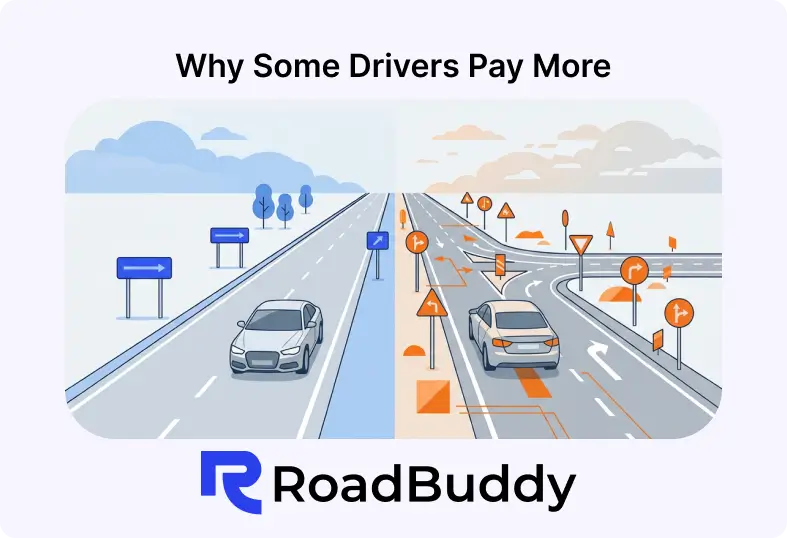
The insurance company`s goal is to set premiums that accurately reflect the cost they`ll pay to settle claims and their operational costs. If a group of drivers is a statistical 50 percent higher risk for claims, they set premiums for those drivers accordingly.
The numbers don’t lie. High-risk drivers end up paying between 25 to 300 percent more per year than standard drivers based on the type of their driving record. In some instances, it can be considered outrageous – high-risk drivers end up paying anywhere from $3,000 to $7,000 per year compared to $1,500 to $2,500 for a driver with a clean driving record.
Make Sure You’re Not Overpaying
You’ll be redirected to our partner’s site to get offers.
Advertiser Disclosure
RoadBuddy is a free resource that helps drivers compare auto insurance options.
We may receive compensation from some insurance companies and partners when you click on links or request a quote through our site. This may affect where offers appear, but it does not influence our reviews, guidance, or editorial decisions.
Our content is researched and written independently to give you clear and unbiased information.
By using RoadBuddy, you acknowledge and accept this disclosure. Learn more.

Young Drivers: The Highest-Risk Category
Young motorists are some of the most expensive to insure. The statistics show that drivers between the ages of 16 and 19 are more likely to be involved in an accident than any other group, which means that their insurance rates are higher.
When you add a 16-year-old to an existing family policy, the premium typically increases by somewhere around $1,200 to $4,000 annually depending on the insurer and your current coverage. If a teenager gets their own policy separate from a parent`s, the costs are even higher – sometimes running $2,000 to $5,000 or more per year for basic coverage.
The good news is that young driver rates drop significantly as they age. A 20-something driver pays noticeably less than a 16-year-old. By the time someone reaches 25 or 30, the “young driver” premium bump disappears entirely.
The good news is that young driver rates drop significantly as they age. A 20-something driver pays noticeably less than a 16-year-old. By the time someone reaches 25 or 30, the “young driver” premium bump disappears entirely.
What affects a young driver`s rates most heavily:
- The vehicle type matters more for young drivers than for older drivers. A 16-year-old driving a four-door sedan pays substantially more than a 16-year-old driving a compact hatchback – sometimes by hundreds of dollars annually.
- Payment method impacts costs. Paying annually saves money compared to monthly payments. For someone already facing high premiums, this can be a meaningful way to reduce annual costs.
- Good grades in school can unlock discounts at some insurers. A good student discount (usually requiring at least a 3.0 GPA) can reduce rates by 10-15 percent at many companies.
- Driver education courses, especially defensive driving courses, sometimes qualify young drivers for discounts that reduce the high-risk premium somewhat.
- Bundling with a parent`s existing home or auto policy often brings better rates than separate policies.
Recent Accidents or Traffic Violations
A recent accident or speeding ticket doesn`t permanently put someone in the high-risk category, but it does significantly increase rates for the period it shows up on their driving record – typically 3 to 5 years depending on the violation type and state.
A single speeding ticket might increase annual premiums by $200 to $500. An at-fault accident can cause increases of $500 to $2,000 or more per year, depending on the accident severity and damage involved.
The timing matters. The impact of a violation or accident is steepest in year one and gradually decreases over time. After 3 to 5 years, many insurance companies will stop factoring it into rates, though different companies have different policies about how far back they look.
Someone with a recent accident can sometimes find better rates by shopping around. Different companies weight accidents differently – a company that charges a heavy premium for an accident might use different risk models than a competitor, resulting in a notably better rate for the same violation.
Make Sure You’re Not Overpaying
You’ll be redirected to our partner’s site to get offers.
Advertiser Disclosure
RoadBuddy is a free resource that helps drivers compare auto insurance options.
We may receive compensation from some insurance companies and partners when you click on links or request a quote through our site. This may affect where offers appear, but it does not influence our reviews, guidance, or editorial decisions.
Our content is researched and written independently to give you clear and unbiased information.
By using RoadBuddy, you acknowledge and accept this disclosure. Learn more.
Suspended License and SR-22 Insurance
Being required to file an SR-22 form means insurance companies view you as a significantly elevated risk. An SR-22 isn`t actually a type of insurance – it`s a certificate of financial responsibility that gets filed with your state`s DMV. It proves to your state that you`re carrying the minimum insurance coverage required.
Common reasons for SR-22 requirements include:
- DUI or DWI conviction
- Driving without insurance
- Driving on a suspended or revoked license
- Multiple traffic violations in a short period
- At-fault accident while uninsured
- Reckless driving conviction
When an SR-22 is mandated, it usually remains on record for a period of 3 years, although some states mandate it for 2 years, and in other cases, it may be for a longer period depending on the nature of the offense. During this time, you are expected to have active insurance coverage. If you allow your coverage to lapse for even a single day, your insurance company is mandated by law to notify the DMV, and this may lead to the suspension of your license once again.
The cost implications of having an SR-22 mandated are quite high. There is a filing fee for the SR-22 document, which may be around $25, but the major cost implication lies in the insurance premium itself. Since SR-22 filers are considered high-risk, the insurance premium may be 50 percent to 200 percent higher than usual depending on the nature of the SR-22 mandate.
A person who owns a 10-year-old vehicle and has an SR-22 mandate may have to rely on high-risk insurance companies that cater to people with problematic driving records. These companies charge much higher premiums but are ready to take the risk that other insurance companies won’t.
Finding Insurance as a High-Risk Driver
The standard insurance companies may also refuse to cover high-risk drivers, which means that the options will be limited. This is where you should look:
High-risk insurance specialists are insurance companies that deal with drivers who have traffic violations, accidents, or suspended licenses. They are more accustomed to dealing with complicated driving records and may have better rates than trying to squeeze yourself into a standard insurance company`s system. They also understand that high-risk drivers are not no-risk drivers and have developed a business model around charging them the right rates.
Independent insurance agents can shop your profile with several insurance companies, including high-risk insurance specialists, to find the best available rate. They can also make phone calls to explain your situation to companies that may be willing to work with you.
Direct companies, like GEICO or State Farm, sometimes have riskier divisions that write insurance for bad driving records. It may be worth calling them and asking if they have insurance available for high-risk drivers, even if their website says you`re not eligible.
Direct carriers like GEICO or State Farm sometimes have higher-risk programs or divisions that write policies for difficult driving histories. It`s worth calling and asking specifically if they have options for high-risk drivers, even if online quotes reject you.
Shopping around matters even more for high-risk drivers. The prices between insurance companies can differ by as much as $2,000 per year for the same person. One insurance company may view a DUI from 4 years ago as very important, while another insurance company barely considers it. Taking the time to get quotes from many insurance companies can be one of the most important things that a high-risk driver can do.
Strategies to Reduce High-Risk Premiums
High premiums are painful, but several strategies can reduce them:
Increase your deductible. For example, increasing the deductible from $500 to $1,000 could save you as much as 20 to 30 percent on your premiums. However, this also means that you will end up paying more out of pocket in the event of a claim. But this is something to consider only if you can afford the increased deductible in the event of a claim.
Bundle policies. Purchasing auto insurance, as well as home, renter, or other types of insurance, can save you 10 to 25 percent on your insurance premiums. If you are already paying high insurance premiums, this can be a big help.
Choose a safer vehicle. Older cars with lower value also mean lower insurance premiums. Cars with high safety ratings and lower repair costs can qualify for lower insurance premiums, unlike cars with high performance ratings or those with higher repair costs.
Usage-based insurance programs. Some insurance companies offer a program where a small device or app monitors your driving habits. Safe drivers qualify for discounts, sometimes 10-30 percent, by demonstrating that you are a safe driver. This could be a benefit for high-risk drivers who are actually driving safely.
Defensive driving courses. Completing a defensive driving course can also get you a discount at most insurers, which could be as much as 5 to 15 percent, and is usually valid for 3 years.
Maintain continuous coverage. Although it may mean paying for insurance that is not being used, it is still important to keep the policy active because lapses can hurt your high-risk rating even further. Insurers view lapses as a bad sign, and some may even charge you higher rates if they see that you have had a lapse in coverage.
Look for age-based discounts. Young drivers will notice that rates decrease as they get older. If you are on the younger side, you should be aware that looking for a new policy every year may show you that your rates decrease as you get older and enter a new rate bracket.
Consider non-owner policies.If you do not own a car but find yourself driving one from time to time, a non-owner policy is significantly cheaper than a full policy on a car you own. This is not something that will come into play for young drivers, but it may be an option if your situation changes.
Make Sure You’re Not Overpaying
You’ll be redirected to our partner’s site to get offers.
Advertiser Disclosure
RoadBuddy is a free resource that helps drivers compare auto insurance options.
We may receive compensation from some insurance companies and partners when you click on links or request a quote through our site. This may affect where offers appear, but it does not influence our reviews, guidance, or editorial decisions.
Our content is researched and written independently to give you clear and unbiased information.
By using RoadBuddy, you acknowledge and accept this disclosure. Learn more.
The Reality of Time and Rate Improvement
The most important thing to understand about being a high-risk driver is that it`s temporary. Insurance companies look back at your driving history for 3 to 7 years depending on the company and violation type. After that time passes with no new violations, your rates drop significantly.
A young driver`s rates improve dramatically just by aging. Someone paying $3,000 annually at age 17 might pay $1,500 by age 25 simply because they`ve aged out of the highest-risk category.
Someone with a DUI or suspension on their record sees rates improve as that event moves further into the past. Three years after the event that triggered the SR-22, rates typically drop. Five years later, many companies will barely factor it in.
This timeline matters because it means high premiums aren`t permanent. It`s a difficult financial situation for a defined period, but rates do improve with time and a clean driving record going forward.
Making It Work
Being a high-risk driver means you have to pay more, but that doesn’t mean you have to pay what the first quote tells you. The goal is not to get the cheapest insurance available but the best insurance available for the price.
And that may mean that you pay a little more than the clean driving record holder would pay, but it doesn’t mean you pay what the insurance company originally quotes you.
As the high-risk situation moves further into the past, the insurance rates get better. In fact, many high-risk drivers find that they can move back into the standard insurance rate group within a few years if they don’t get into any further trouble or have an accident. The future is a wonderful place to look toward.
Table of contents

Looking for Auto Insuranse?
Make sure you’re not overpaying
You’ll be redirected to our partner’s website to compare personalized offers.
Advertiser Disclosure
RoadBuddy is a free resource that helps drivers compare auto insurance options.
We may receive compensation from some insurance companies and partners when you click on links or request a quote through our site. This may affect where offers appear, but it does not influence our reviews, guidance, or editorial decisions.
Our content is researched and written independently to give you clear and unbiased information.
By using RoadBuddy, you acknowledge and accept this disclosure. Learn more.