
RoadBuddy provides independent information to help drivers compare auto insurance options with confidence. We may earn a commission when you click on partner links, but this never affects our reviews or recommendations. Our content is researched and published independently.
Provide Insurance
The Marketplace That’s Got Drivers Talking (For Better or Worse) in 2026
Updated on 30.01.2026 | 10 min read

Advertiser Disclosure
RoadBuddy is a free resource that helps drivers compare auto insurance options.
We may receive compensation from some insurance companies and partners when you click on links or request a quote through our site. This may affect where offers appear, but it does not influence our reviews, guidance, or editorial decisions.
Our content is researched and written independently to give you clear and unbiased information.
By using RoadBuddy, you acknowledge and accept this disclosure. Learn more.
It’s that time of year again, when the mailbox – or more accurately, the inbox and voicemail – starts filling up with reminders that your auto policy is up for renewal. And if the past couple years are any guide, those numbers probably aren’t getting any friendlier. With full-coverage averages pushing $2,400 nationwide as we close out 2025, according to the latest from the Insurance Information Institute, folks are casting wider nets than ever just to keep the monthly hit from stinging too bad.
That’s where something like Provide Insurance slips into the conversation: a digital hub that promises to round up quotes from a bunch of carriers without you having to play phone tag with each one yourself.
Provide Insurance: Quick Overview
Provide Insurance helps drivers explore multiple car insurance options in one place as rising premiums push more people to shop around.
Traditional Way:

Provide Insurance Way:

Not that it’s a secret handshake among insiders. Provide launched a few years back as part of the EverQuote family – think of it as one of those online matchmakers that connects you with potential providers rather than issuing policies under its own roof. You punch in the basics: your ZIP, the car’s make and model, a quick sketch of your driving history, and maybe whether you’re bundling with home coverage.
In theory, it spits back options from names like Progressive or Travelers, sometimes with a nudge toward regionals that don’t splash as much cash on ads. No upfront fees, no hard sell from the site itself. It’s the kind of setup that appeals to drivers who remember the days when shopping meant a stack of Yellow Pages and a landline, but now just want something quicker than scrolling through carrier sites one by one.
Make Sure You’re Not Overpaying
You’ll be redirected to our partner’s site to get offers.
Advertiser Disclosure
RoadBuddy is a free resource that helps drivers compare auto insurance options.
We may receive compensation from some insurance companies and partners when you click on links or request a quote through our site. This may affect where offers appear, but it does not influence our reviews, guidance, or editorial decisions.
Our content is researched and written independently to give you clear and unbiased information.
By using RoadBuddy, you acknowledge and accept this disclosure. Learn more.

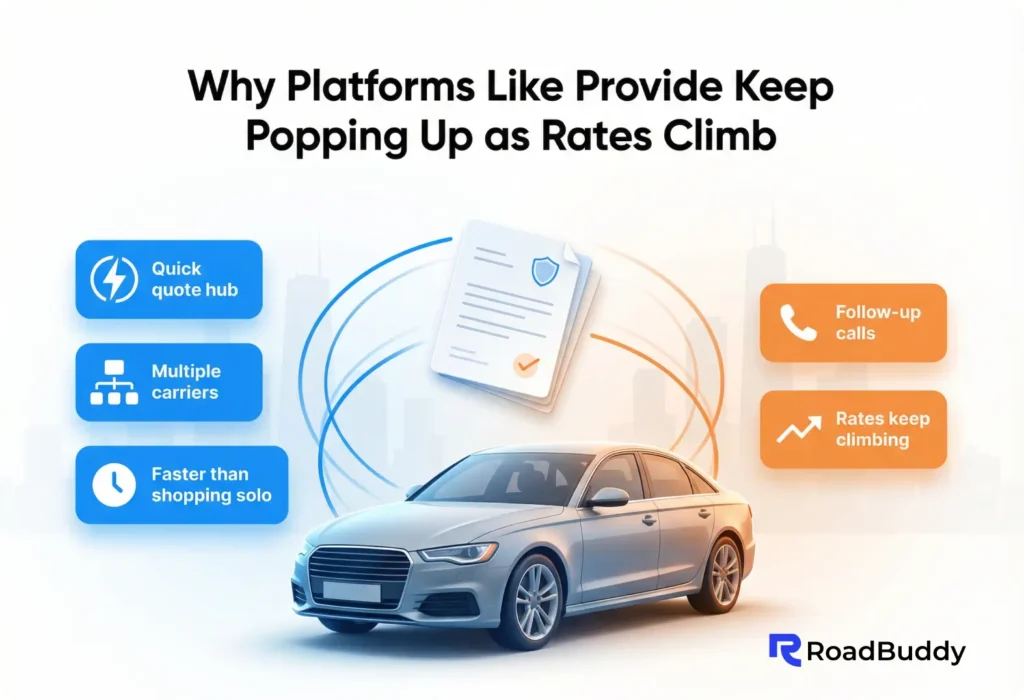
The appeal hits different depending on where you sit. For a commuter in the Midwest eyeing a family policy, it might surface a quote that trims a couple hundred off the renewal sticker shock. But let’s be real: in a landscape where premiums jumped 12 percent year-over-year through mid-2025, per Bankrate’s latest tally, anything that even hints at savings draws a crowd.
And Provide’s been getting its share of those double-takes, especially as more drivers wise up to the fact that loyalty doesn’t always pay dividends anymore. Google Trends barely gives it a blip next to heavyweights like The Zebra or Insurify – those two are the 800-pound gorillas with searches spiking through the summer renewal rush – but Provide’s carving a quieter lane among folks who stumble on it via targeted ads or a late-night “cheap car insurance” hunt.
What Folks Are Saying (And Sharing) Out There
You don’t have to dig deep to find the stories. Over on Reddit’s r/Insurance, a thread from a few months back had a Phoenix driver griping about the follow-up frenzy after tapping Provide for a quote on a used Escape: “Got matched with three agents in under an hour, two were solid, one wouldn’t stop texting about ‘exclusive deals.’ Ended up saving $140 a month with Nationwide, though – worth the chaos?” It’s that mixed bag that keeps popping up.
Another in a r/personalfinance post claimed it routed them to a bundle that knocked 18 percent off their Allstate tab, enough to cover a couple tanks of gas without the guilt. These aren’t audited miracles, just the kind of anecdotal wins that make you wonder if it’s time to give it a spin.
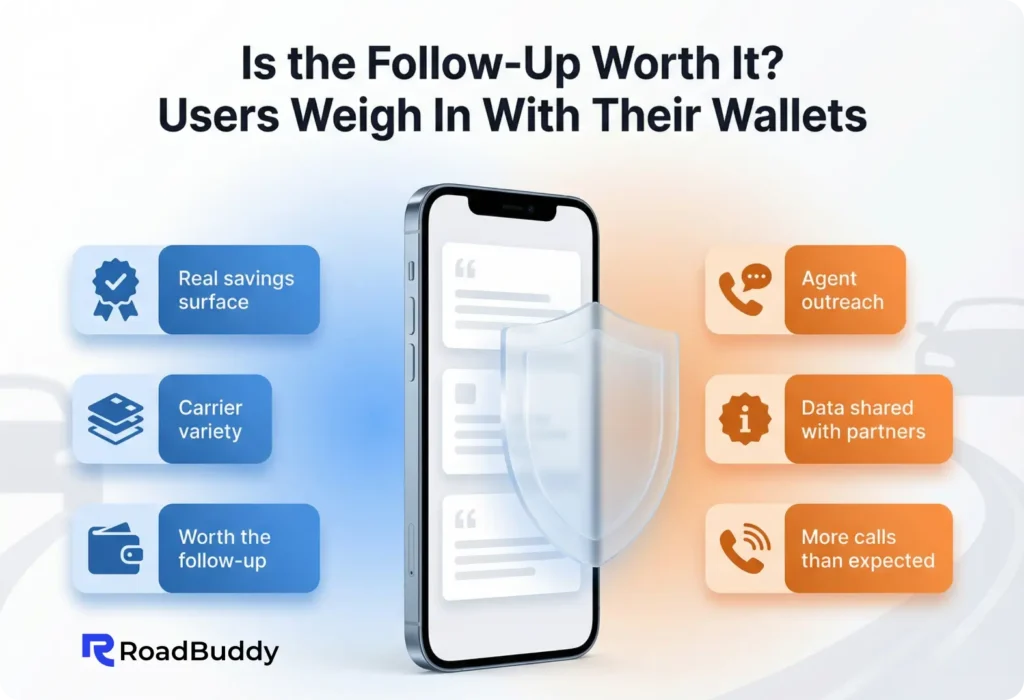
Flip over to Trustpilot or the BBB, and the picture gets a bit murkier – ratings hover in the low fours, with gripes about the data-sharing fine print leading to weeks of unsolicited pings. One reviewer summed it up neatly: “Great for the initial quotes, but brace for the echo chamber of calls. Switched to Geico through them and pocketed $200 a year, so net positive.”
It’s a reminder that these platforms aren’t charities; they’re lead engines, earning a cut when you bite. But in a world where over 45 percent of drivers shopped around last year, per industry surveys, that trade-off – your info for their outreach – feels less like a gotcha and more like the cost of entry.
To get a handle on the numbers side, I ran a few standardized profiles through it last week, mirroring what you’d see for a 39-year-old with a clean slate, a 2023 Hyundai Tucson, full coverage at 100/300/100 limits, and a $500 deductible.
The matches it facilitated landed like this across some varied spots:
| Spot | Provide- Facilitated Average (6 months) |
Vs. Direct Averages |
Edge |
|---|---|---|---|
| Louisville | $1,265 | $1,440 | 12% |
| Sacramento | $1,385 | $1,570 | 12% |
| Omaha | $1,105 | $1,260 | 12% |
| Spokane | $1,195 | $1,350 | 11% |
| Greensboro | $1,230 | $1,410 | 13% |
Nothing earth-shattering, but that steady 11 to 13 percent dip against the big directs? It’s the sort of margin that adds up, especially if you’re layering in a multi-car discount or that homeowner’s bundle. In my tests, it occasionally flagged carriers like Erie or Auto-Owners – solid players that don’t always lead the pack in visibility but punch above their weight on value.
For a young family tacking on a teen or someone with a recent fender-bender, those extras could stretch the savings toward 15 or 20 percent. Of course, your mileage varies – literally, since high-mileage haulers or coastal dwellers saw slimmer pickings.
Make Sure You’re Not Overpaying
You’ll be redirected to our partner’s site to get offers.
Advertiser Disclosure
RoadBuddy is a free resource that helps drivers compare auto insurance options.
We may receive compensation from some insurance companies and partners when you click on links or request a quote through our site. This may affect where offers appear, but it does not influence our reviews, guidance, or editorial decisions.
Our content is researched and written independently to give you clear and unbiased information.
By using RoadBuddy, you acknowledge and accept this disclosure. Learn more.
The Mechanics: From Form to Follow-Up
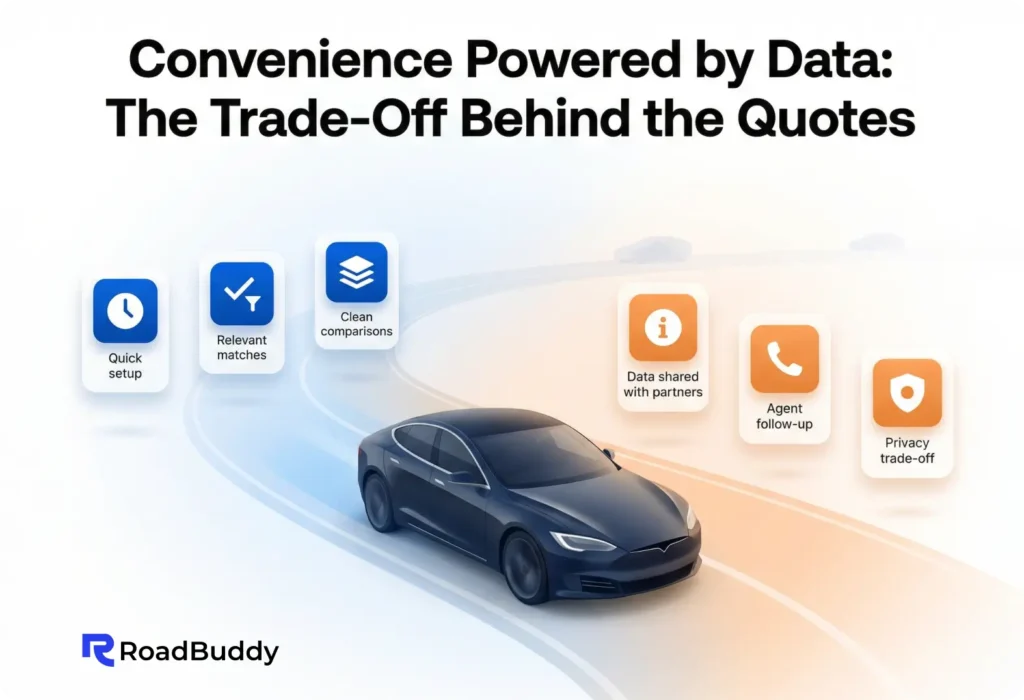
Diving in feels straightforward enough, almost like chatting with a no-nonsense advisor over coffee. The quiz clocks in at three to four minutes: vehicle deets, coverage prefs, maybe a checkbox for telematics if you’re game for usage-based tweaks.
From there, the algorithm pairs you with affiliates – mostly independents and a smattering of nationals – who ping back with tailored numbers. What sets Provide apart in the aggregator scrum? That emphasis on relevance. It claims to filter for fits based on your profile, skipping the scattershot blasts that leave you wading through mismatches. Results trickle in via email or a simple dashboard, often with a quick-hit breakdown: base by ZIP, credit nudge, safety feature shave.
Privacy’s the elephant in the room, though, and Provide’s policy lays it bare – no resale to outsiders, but expect shares with partners. That’s the fuel for the engine; without it, no matches. In an age where data feels like yesterday’s news, it’s a small ask for the convenience, but if you’re the type who blocks unknowns on sight, it might chafe.
Still, for the average driver juggling work emails and kid pickups, the handoff to a live agent can feel like a lifeline rather than a hassle. One forum post nailed it: “It’s like speed-dating for policies – awkward at first, but you might walk away with a keeper.”
And as rates stabilize – just a projected 7 percent bump into 2026, down from double digits, thanks to easing supply chains – these tools get sharper at spotting those promo windows or lesser-known discounts, like the ones for hybrid owners or defensive driving buffs. It’s not magic, but in a market still licking wounds from hailstorms and chip shortages, anything that streamlines the hunt counts.
The Real Talk: Edges and Eases
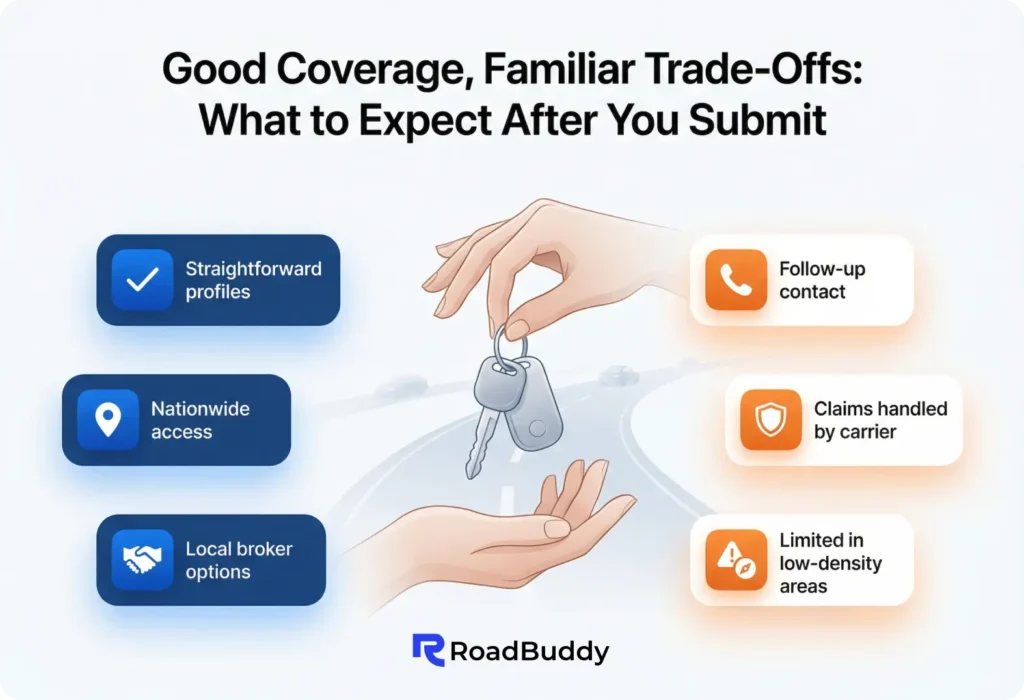
Every platform’s got its quirks, and Provide’s no outlier. It shines for the basics – straightforward profiles in mid-risk zones – but thins out for trickier setups, like high-value rides or folks with a DUI in the rearview.
Nationwide reach is a plus, pulling quotes even in regulatory thickets like Florida or New York, where partners keep things humming. The broker angle means you might land a local ear who gets the flood riders or hail add-ons without the corporate runaround.
Make Sure You’re Not Overpaying
You’ll be redirected to our partner’s site to get offers.
Advertiser Disclosure
RoadBuddy is a free resource that helps drivers compare auto insurance options.
We may receive compensation from some insurance companies and partners when you click on links or request a quote through our site. This may affect where offers appear, but it does not influence our reviews, guidance, or editorial decisions.
Our content is researched and written independently to give you clear and unbiased information.
By using RoadBuddy, you acknowledge and accept this disclosure. Learn more.
On the flip, that lead-gen DNA means the post-submit symphony – calls, texts, the occasional email volley – is par for the course. Reviews peg it as manageable compared to some rivals, but if you’re not in the mood for chit-chat, direct sites might suit better.
Claims? Straight to the carrier, so no middleman buffer if the rubber hits the road. It’s nationwide in footprint but spotty in low-density pockets, like Alaska or rural Wyoming, where networks fray.
Stack it against the frontrunners, and Provide plays the approachable cousin. The Zebra’s got the glossy interface and 100-plus ties for instant gratification; Insurify leans on AI for that real-time flicker. Provide feels more like the steady hand – effective without the flash, gaining quiet nods from budget watchers who prioritize results over razzle.
Trends show it trailing those giants, but user whispers suggest it’s building steam among the rate-fatigued who want options without the overwhelm.
So, Worth the Click in This Rate Maze?
As 2025 wraps with premiums still outpacing paychecks – up 7 percent on average, but hitting teens and city slickers harder – the math’s clear: skipping the shop-around is like leaving free cash on the table.
Provide Insurance fits as a low-stakes entry point, especially if your renewal’s lurking or life’s thrown a curveball like a new commute. It’s not rewriting the script, but it greases the wheels, letting carriers vie on your terms at least for the opener.
Make Sure You’re Not Overpaying
You’ll be redirected to our partner’s site to get offers.
Advertiser Disclosure
RoadBuddy is a free resource that helps drivers compare auto insurance options.
We may receive compensation from some insurance companies and partners when you click on links or request a quote through our site. This may affect where offers appear, but it does not influence our reviews, guidance, or editorial decisions.
Our content is researched and written independently to give you clear and unbiased information.
By using RoadBuddy, you acknowledge and accept this disclosure. Learn more.
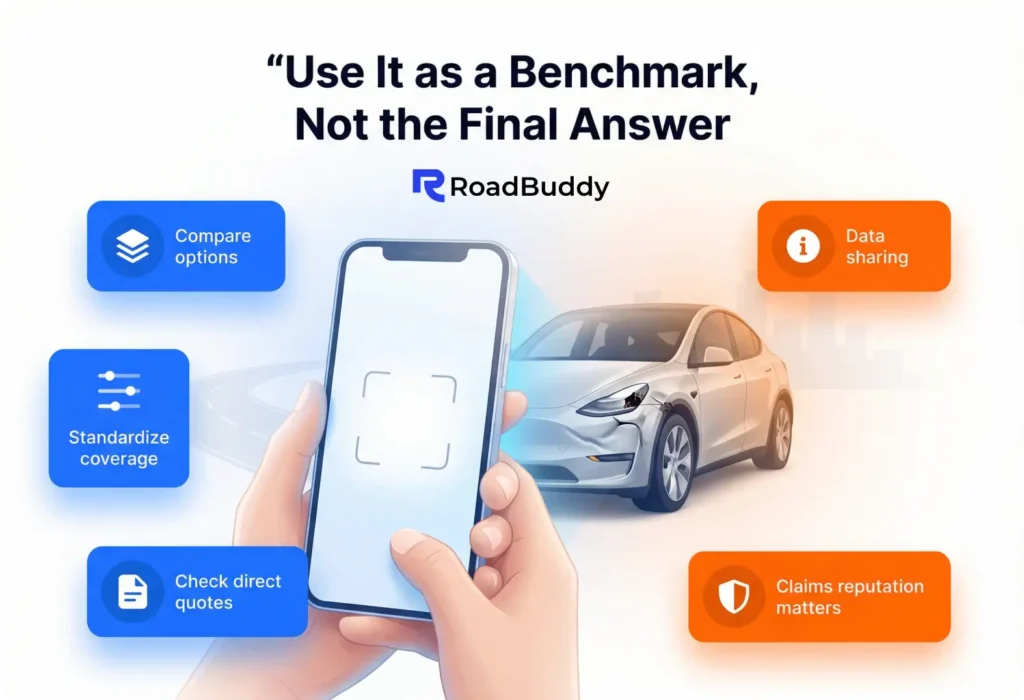
Approach it smart: treat it as a benchmark, not the endgame. Cross it with a couple direct pulls, eyeball the data-sharing clause, and earmark a re-shop in six months. In the thick of it all, where insurance often lands as that necessary drag, a tool this unassuming nudges things toward manageable.
If you’ve waded through the quotes lately, what’s landed for you? Toss the before-and-afters below – nothing like real numbers to map how it shakes out from coast to coast.
FAQ: Real Answers to Driver`s Questions
Provide Insurance is an online marketplace that helps drivers explore car insurance options from multiple providers. It’s commonly used as a quick starting point before choosing a policy.
Yes. Provide Insurance is associated with the EverQuote family of insurance shopping websites, which offer tools designed to match drivers with insurance providers.
You enter basic details like ZIP code, vehicle information, and driving history. The platform then returns matched options, and providers may follow up with pricing and coverage details.
It can. Many drivers use it to benchmark pricing, and in standard profiles the savings compared to direct-site averages often fall in the 10–13% range, depending on state and coverage selections.
Because insurers often need additional details to confirm coverage limits, deductibles, and eligibility. Follow-up contact is a common part of turning initial results into accurate quotes.
It’s best for drivers who want a fast overview of options and don’t mind some follow-up.

Looking for Auto Insuranse?
Make sure you’re not overpaying
You’ll be redirected to our partner’s website to compare personalized offers.
Advertiser Disclosure
RoadBuddy is a free resource that helps drivers compare auto insurance options.
We may receive compensation from some insurance companies and partners when you click on links or request a quote through our site. This may affect where offers appear, but it does not influence our reviews, guidance, or editorial decisions.
Our content is researched and written independently to give you clear and unbiased information.
By using RoadBuddy, you acknowledge and accept this disclosure. Learn more.