
RoadBuddy provides independent information to help drivers compare auto insurance options with confidence. We may earn a commission when you click on partner links, but this never affects our reviews or recommendations. Our content is researched and published independently.
Car Insurance Discounts & Saving Tips: Ensure You are Not Overpaying
Published 01.02.2026 | 9 min read
Advertiser Disclosure
RoadBuddy is a free resource that helps drivers compare auto insurance options.
We may receive compensation from some insurance companies and partners when you click on links or request a quote through our site. This may affect where offers appear, but it does not influence our reviews, guidance, or editorial decisions.
Our content is researched and written independently to give you clear and unbiased information.
By using RoadBuddy, you acknowledge and accept this disclosure. Learn more.
Most people don’t realize how many discounts are sitting on the table that they’re just not asking for. Insurance companies don’t advertise all their available discounts equally. Some are well-known, while others remain hidden unless you know to look.
The good news is that discounts are real and add up quickly. A combination of several discounts can reduce your annual premium by hundreds of dollars. The catch is that almost none of them apply automatically. You have to know they exist, qualify for them, and in many cases, actually ask for them.
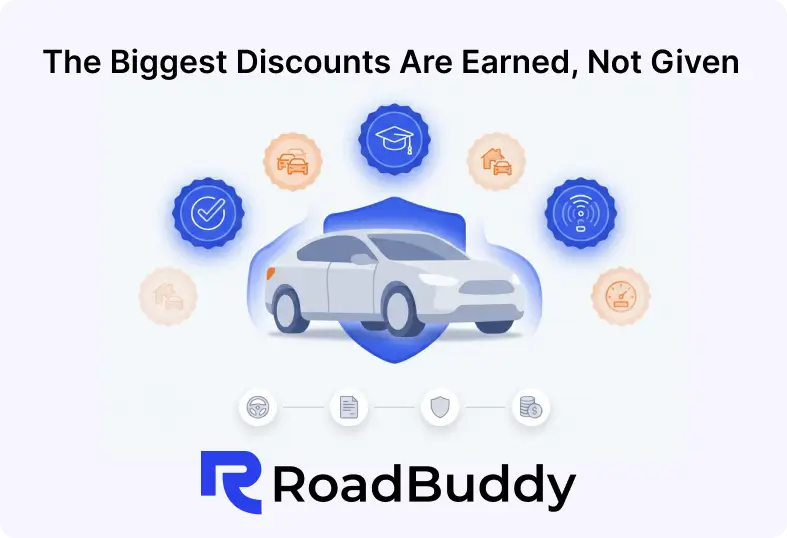
The Big Discounts Worth Chasing
Good Driver Discount
This is often the single biggest discount available and the most commonly missed one. Insurance companies reward drivers who maintain clean records with no accidents or traffic violations typically over a 3-5 year period.
The savings are substantial: most companies offer between 10-30 percent off for good driver status. In real dollars, if your full coverage quote is around $2,500 annually, a good driver discount could save you $250 to $750 per year.
Here’s the catch: this discount isn’t always applied automatically. Many people have clean driving records but never call their insurance company to mention it or ask if they qualify. Some companies do apply it without asking, but others require you to request it during renewal or at policy review time.
If you’ve maintained a clean driving record for at least three years with no accidents and no traffic violations, call your insurer and specifically ask if you qualify for a good driver discount. Don’t assume they’ve already given it to you.
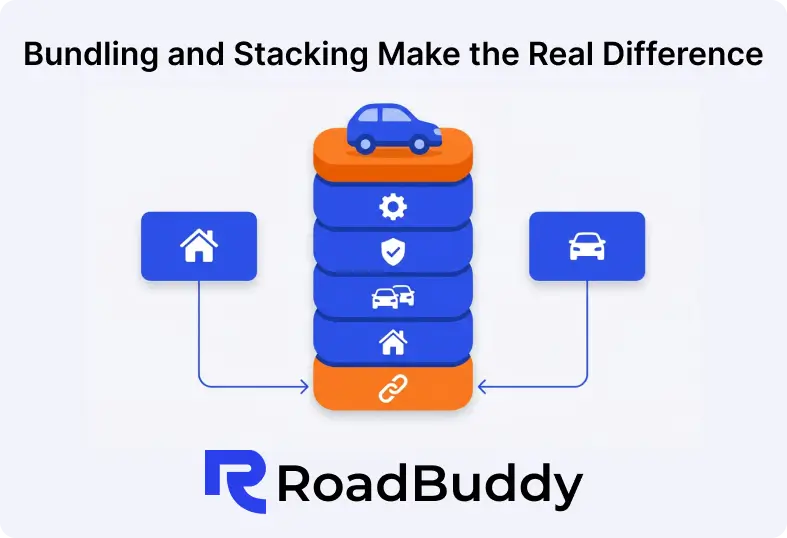
Bundling: The Easiest High-Value Discount
If you have home, renters, or any other insurance policy, bundling with your auto insurance typically saves 7-25 percent on your total premiums. Some companies push bundling discounts even higher: certain carriers offer up to 40 percent bundling savings for homeowners.
If you’re currently paying $1,200 annually for auto insurance and $1,500 for home insurance (totaling $2,700), bundling might reduce that to around $2,200 combined. That’s $500 in annual savings just for putting both policies in one place.
Beyond the discount, bundling simplifies your life. One agent or customer service contact, one online portal to manage both policies, one billing date instead of two. For some people, that convenience is worth the discount by itself.
Make Sure You’re Not Overpaying
You’ll be redirected to our partner’s site to get offers.
Advertiser Disclosure
RoadBuddy is a free resource that helps drivers compare auto insurance options.
We may receive compensation from some insurance companies and partners when you click on links or request a quote through our site. This may affect where offers appear, but it does not influence our reviews, guidance, or editorial decisions.
Our content is researched and written independently to give you clear and unbiased information.
By using RoadBuddy, you acknowledge and accept this disclosure. Learn more.
Good Student Discount
If you have a student on your policy (or you’re a student yourself), a good student discount typically saves 10-15 percent on premiums. Most companies define “good student” as maintaining at least a 3.0 GPA in high school or college, and the student usually needs to be under 25 years old to qualify.
The discount requires proof. Most insurers ask for a report card or transcript. It’s not a huge discount individually, but combined with other discounts it becomes meaningful.
Multi-Car Discount
If you insure more than one vehicle with the same company, you typically get a discount on both. Multi-car discounts usually range from 7-25 percent per vehicle. GEICO offers one of the largest multi-car discounts at up to 25 percent for adding additional vehicles to a policy.
For families with multiple vehicles, this is one of the easiest discounts to capture. It usually applies automatically once you add a second or third car, but it’s worth confirming when you’re adding a new vehicle.
Make Sure You’re Not Overpaying
You’ll be redirected to our partner’s site to get offers.
Advertiser Disclosure
RoadBuddy is a free resource that helps drivers compare auto insurance options.
We may receive compensation from some insurance companies and partners when you click on links or request a quote through our site. This may affect where offers appear, but it does not influence our reviews, guidance, or editorial decisions.
Our content is researched and written independently to give you clear and unbiased information.
By using RoadBuddy, you acknowledge and accept this disclosure. Learn more.
Vehicle-Based Discounts
Safety Features
Modern cars come equipped with safety technology that reduces accident risk: automatic emergency braking, forward collision warning, blind spot detection, stability control. Insurance companies recognize this and offer discounts for vehicles with these features.
The discounts vary by company and feature, but they typically range from 2-10 percent depending on which safety systems your car has. Some companies specifically reward newer vehicles with advanced safety systems more generously than others.
Make sure your insurer knows what safety features your car has. When you’re shopping for insurance or renewing your policy, specifically mention any advanced safety systems. Some companies won’t know to check unless you tell them.
Anti-Theft Devices
If your vehicle has an alarm, a tracking system, or a kill-switch, you might qualify for an anti-theft discount. These typically range from 2-5 percent, which is modest but adds to other discounts you’re stacking.
New Car Discount
Some insurers offer discounts if you own or lease a vehicle that’s three or fewer years old, typically around 10 percent. The logic is that newer vehicles have the latest safety technology and are typically cheaper to repair.
Stacking Multiple Discounts
The key insight most people miss is that discounts stack. You can often combine good driver discount + bundling discount + multi-car discount + safety features discount in the same policy.
Here’s a realistic example: Start with a base rate of $2,500 annually for full coverage. Apply a good driver discount of 25 percent ($625 off = $1,875). Then add a bundling discount of 15 percent ($1,875 × 0.15 = $281 off = $1,594). Then add a safety features discount of 5 percent ($1,594 × 0.05 = $80 off = $1,514).
You’re now paying $1,514 instead of $2,500, that’s 40 percent in total savings just from combining three discounts most people don’t actively pursue.
There are limits, though. Most insurers cap total discounts somewhere between 25-35 percent of your premium, so you can’t discount forever. But within that cap, stacking works and makes a real financial difference.
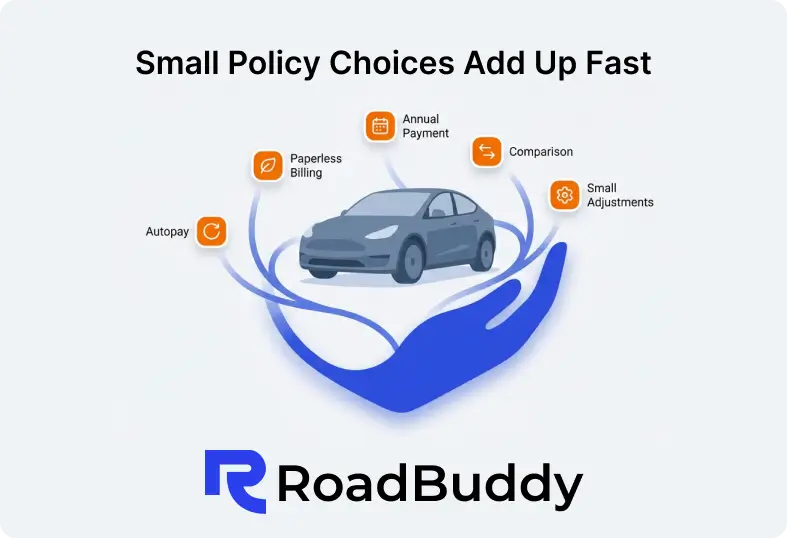
Payment and Policy Discounts
Paid-in-Full Discount
Paying your entire premium at the beginning of the year instead of monthly typically saves 5-9 percent. This is one of the easiest discounts to capture if you have the cash available with no qualification needed, just pay upfront.
If you’re paying $1,500 annually in monthly increments at $150/month, paying in full might bring that down to around $1,400 annually. For some companies, it could be even lower.
Automatic Payment Discount
Even if you can’t afford to pay the whole year upfront, setting up automatic electronic payments typically saves 3-5 percent compared to manual payments. Most companies offer this automatically if you enroll in autopay, but confirm it’s been applied to your policy.
Paperless/Electronic Billing Discount
Going paperless by managing your policy online and receiving your bills electronically can save 1-4 percent, depending on the company. It’s modest, but it costs nothing and takes seconds to set up.
Make Sure You’re Not Overpaying
You’ll be redirected to our partner’s site to get offers.
Advertiser Disclosure
RoadBuddy is a free resource that helps drivers compare auto insurance options.
We may receive compensation from some insurance companies and partners when you click on links or request a quote through our site. This may affect where offers appear, but it does not influence our reviews, guidance, or editorial decisions.
Our content is researched and written independently to give you clear and unbiased information.
By using RoadBuddy, you acknowledge and accept this disclosure. Learn more.
How to Actually Get These Discounts
Knowing discounts exist and actually capturing them are different things. Here’s how to actually apply them:
Call and ask directly. If you already have insurance, call your agent or customer service and say: “I’d like to review what discounts I currently have on my policy.” Then ask specifically about good driver discounts, bundling (if applicable), student discounts (if applicable), safety feature discounts, and any professional or group memberships you belong to.
Shop around to verify. Different companies weight different discounts. One company might give you a 30 percent good driver discount while another gives 15 percent for the same clean record. Getting quotes from three or four carriers lets you compare not just the bottom-line price but also what discounts are applied and at what percentage.
Provide supporting documentation. For some discounts (good student, defensive driving course completion, safety features), you need to provide proof. Have your report card ready for a good student discount, have proof of course completion for a defensive driving discount, and make sure your VIN is correctly registered with the vehicle’s actual safety features listed.
Bundle if you haven’t yet. If you’re carrying home, renters, life, or any other insurance, call each provider and ask what discount you’d get by consolidating everything with them. Often bundling one other policy brings immediate savings.
Set up autopay and go paperless. These are essentially free and take a few minutes to set up online and trim a few percent off your premium automatically.
The Ones to Ask About Specifically
Defensive Driving Course Discount
Completing a state-approved defensive driving course typically unlocks a 5-15 percent discount, depending on your age and the company. Some companies even offer higher discounts for seniors who complete a mature driver course, sometimes 15-35 percent.
The discount usually lasts 3 years, after which you’d need to take the course again if you want to maintain the discount. For high-risk drivers or anyone paying elevated premiums, taking a defensive driving course can be one of the highest-ROI ways to reduce rates.
Occupational or Group Membership Discounts
Some professions and memberships come with discounts. Teachers, military personnel, engineers, nurses, and employees of certain large companies often qualify for group discounts through their workplace. Alumni associations, professional memberships, AAA, AARP, and union memberships sometimes include insurance discounts as well.
These vary wildly, military discounts can be 15-25 percent, AARP membership typically includes 10-15 percent off, and other occupational/group discounts vary.
Homeowner Discount
If you own a home (which most homeowners insurance customers do), you often get a small discount for being a homeowner, typically 4-12 percent depending on the company.
This is strange because most people bundle home and auto anyway, getting the bundling discount automatically. But some companies offer both, the homeowner discount and the bundling discount, so it’s worth asking.
Make Sure You’re Not Overpaying
You’ll be redirected to our partner’s site to get offers.
Advertiser Disclosure
RoadBuddy is a free resource that helps drivers compare auto insurance options.
We may receive compensation from some insurance companies and partners when you click on links or request a quote through our site. This may affect where offers appear, but it does not influence our reviews, guidance, or editorial decisions.
Our content is researched and written independently to give you clear and unbiased information.
By using RoadBuddy, you acknowledge and accept this disclosure. Learn more.
What Doesn’t Stack and Watch-Outs
Some discounts cancel each other out. If you claim one discount, your insurer might reduce or eliminate another. For example, some companies have a loyalty discount and an early-sign discount, you get one or the other, not both. Ask about this when reviewing your discounts.
Discounts apply to different parts of your policy. A discount might only apply to comprehensive coverage or only to liability coverage, not your entire bill. So when a company advertises “up to 30 percent off,” the discount might only apply to a specific portion of your coverage. The final savings will be less than 30 percent of your total premium.
Not all discounts are available everywhere. Some discounts are state-specific due to state insurance regulations. Usage-based insurance discounts, for example, aren’t available in California due to state law prohibiting usage-based pricing models.
You might lose a discount if you make a claim. This varies by company, but some discounts (especially paid-in-full or low-mileage discounts) might be forfeited if you file a claim in the discount period.
Common Coverage Issues and What to Know
“My claim was denied because of a pre-existing condition.”
Pre-existing conditions are typically handled in health insurance, not auto insurance. In auto insurance, pre-existing damage means damage that existed before the accident. If your insurer claims pre-existing damage denial, verify whether the damage they’re referring to actually predates this accident. Photos of your vehicle before the accident can dispute this.
“My deductible is higher than the damage estimate.”
If your deductible ($500, $1,000, etc.) is higher than the repair estimate, you typically won’t file a claim – you’ll just pay for repairs out of pocket. Filing a claim when the damage is less than your deductible doesn’t make financial sense and can affect your rates.
“I was told I’m partially at fault.”
In some states, you can recover a percentage of damages even if you’re partially at fault. In other “comparative fault” states, your recovery is reduced by your percentage of fault. Your state’s laws determine how this works.
“The estimate I got is higher than what the insurance company will approve.”
Insurance companies sometimes approve repair amounts based on their pricing guidelines, not the actual repair shop’s estimate. If you believe their estimate is too low, you can request that your repair shop submit their own estimate explaining why costs are higher. You may need a second opinion or to dispute the adjuster’s estimate.
The Reality of How Much You Can Actually Save
The realistic savings range from 15-40 percent of your base premium depending on how many discounts apply to your situation.
Someone with a clean driving record, bundled policies, a newer car with safety features, and good credit might stack discounts to hit a 35-40 percent reduction. Someone who just gets a good driver discount and goes paperless hits 10-15 percent.
The difference between accepting the first quote you get and spending 30 minutes calling to ask about discounts and getting quotes from two other companies often equals hundreds of dollars in annual savings.
The discounts are there. They’re substantial. The only thing standing between you and significant savings is picking up the phone or spending 20 minutes getting quotes online to see what actually applies to your situation.

Looking for Auto Insuranse?
Make sure you’re not overpaying
You’ll be redirected to our partner’s website to compare personalized offers.
Advertiser Disclosure
RoadBuddy is a free resource that helps drivers compare auto insurance options.
We may receive compensation from some insurance companies and partners when you click on links or request a quote through our site. This may affect where offers appear, but it does not influence our reviews, guidance, or editorial decisions.
Our content is researched and written independently to give you clear and unbiased information.
By using RoadBuddy, you acknowledge and accept this disclosure. Learn more.