
RoadBuddy provides independent information to help drivers compare auto insurance options with confidence. We may earn a commission when you click on partner links, but this never affects our reviews or recommendations. Our content is researched and published independently.
Advertiser Disclosure
RoadBuddy is a free resource that helps drivers compare auto insurance options.
We may receive compensation from some insurance companies and partners when you click on links or request a quote through our site. This may affect where offers appear, but it does not influence our reviews, guidance, or editorial decisions.
Our content is researched and written independently to give you clear and unbiased information.
By using RoadBuddy, you acknowledge and accept this disclosure. Learn more.
The requirements for the type of auto insurance needed to drive legally are different for each state. Why should this matter to you? It will impact the cost of the insurance, the types of risks it will help protect you against, and the consequences of an accident.
The basics are simple: all states but one require some type of auto insurance. The question, of course, becomes exactly what the state means by the phrase “some type.” The types of requirements can vary significantly, such as the minimum liability limits, additional requirements that other states don’t impose, or the overall system of insurance itself.

Why States Have Different Requirements
Each state is responsible for its own insurance, so each state establishes its own minimums based on its own accident patterns, medical expenses in that area, and the state’s lawmakers’ agendas. For example, the insurance minimums in California have just been raised for the first time in almost 60 years.
This creates a situation where what is adequate in one state may not be adequate in another. What is adequate in New York may not be adequate in North Carolina. A person moving from one state to another who already has insurance must check to see if his insurance is adequate for his new state of residence.
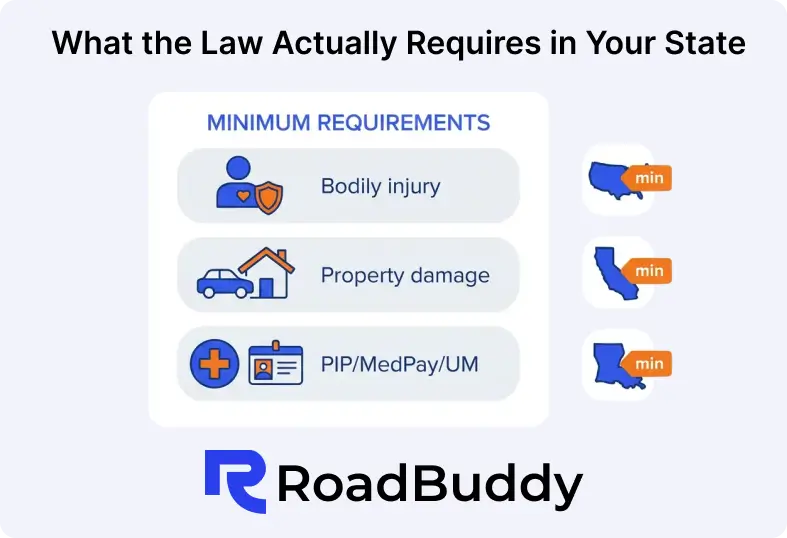
The Three Main Coverage Types States Require
The majority of state mandates are based on three types of coverage, although not all states mandate all three:
Bodily Injury Liability pays for medical bills, lost income, and attorney fees if you are found to be at fault and cause injury to another driver or pedestrian. This is by far the most widely required type of insurance in all states.
Property Damage Liability will cover the cost of another person’s car or property if you are responsible for the accident. If you break someone’s fence or damage a parked car, this insurance will cover the cost of repairs.
Personal Injury Protection (PIP) or Medical Payments Coverage pays for your own medical bills after an accident, regardless of fault. Some states require one, some require the other, and some require neither.
Make Sure You’re Not Overpaying
You’ll be redirected to our partner’s site to get offers.
Advertiser Disclosure
RoadBuddy is a free resource that helps drivers compare auto insurance options.
We may receive compensation from some insurance companies and partners when you click on links or request a quote through our site. This may affect where offers appear, but it does not influence our reviews, guidance, or editorial decisions.
Our content is researched and written independently to give you clear and unbiased information.
By using RoadBuddy, you acknowledge and accept this disclosure. Learn more.

Major States: What You Actually Need to Carry
The details matter because what you pay and what protects you depends on your specific state’s rules.
California (effective January 1, 2025)
California just raised its minimums for the first time in nearly 60 years. Drivers now need:
- $30,000 bodily injury liability per person
- $60,000 bodily injury liability per accident
- $15,000 property damage liability per accident
These minimums apply if you’re at fault. Your insurer pays up to these limits if you’re found liable, and you’re responsible for any costs beyond that. California doesn’t require Personal Injury Protection, though some people add it anyway.
New York
New York requires drivers to carry:
- $25,000 bodily injury liability per perso
- $50,000 bodily injury liability per accident
- $10,000 property damage liability per accident
New York also uniquely requires $50,000 in Personal Injury Protection coverage plus $25,000 in uninsured motorist coverage per person. This means if you cause an accident, your liability coverage kicks in for the other party, but your PIP covers your own medical bills regardless of fault.
Florida
Florida is unusual because it doesn’t require bodily injury liability coverage – only property damage liability and Personal Injury Protection. You need:
- $10,000 property damage liability per accident
- $10,000 Personal Injury Protection per person
This is the lowest property damage minimum requirement of any state requiring coverage. The trade-off is that if you injure someone and don’t have bodily injury coverage (which is optional), they’d have to pursue a lawsuit against you personally to recover medical expenses beyond what PIP covers.
Texas
Texas requires:
- $30,000 bodily injury liability per person
- $60,000 bodily injury liability per accident
- $25,000 property damage liability per accident
No personal injury protection or medical payments coverage is required.
Other Significant States
For the most part, the rest of the states have the same requirements.
Other states have higher requirements than the aforementioned states. In Maine and North Carolina, the requirements are at least 50/100/25, which is twice the bodily injury liability of the other states.
The requirements in Maine are more stringent because the cost of accidents and medical expenses incurred are higher.
The requirements in Pennsylvania are the lowest, at 15/30/5, or $15,000/$30,000/$5,000.
New Hampshire is the only state that does not require insurance, but you must show proof of financial responsibility if you are involved in an accident and are at fault.
Recent Changes: What’s New in 2025
Several states increased their minimum requirements in 2025, reflecting higher costs for accidents and medical care:
- California increased from 15/30/5 to 30/60/15, the first increase in nearly 60 years.
- Utah raised limits to 30/65/25 and now requires $3,000 in Personal Injury Protection as a no-fault state.
- Virginia increased to 50/100/25, making bodily injury requirements much more substantial.
- North Carolina now requires 50/100/50, giving it the highest property damage minimum in the nation at $50,000.
If you’re in any of these states and haven’t updated your policy since late 2024, checking that you meet the new 2025 minimums is worth doing when your policy renews.
Make Sure You’re Not Overpaying
You’ll be redirected to our partner’s site to get offers.
Advertiser Disclosure
RoadBuddy is a free resource that helps drivers compare auto insurance options.
We may receive compensation from some insurance companies and partners when you click on links or request a quote through our site. This may affect where offers appear, but it does not influence our reviews, guidance, or editorial decisions.
Our content is researched and written independently to give you clear and unbiased information.
By using RoadBuddy, you acknowledge and accept this disclosure. Learn more.
Special Insurance Systems: No-Fault States
There are some states that have a “no-fault” policy, which means that your insurance company will cover the cost of your medical expenses, regardless of who is at fault in the accident. In these states, you will need to have Personal Injury Protection (PIP) insurance, either in addition to or instead of bodily injury liability insurance. Those include Florida, Hawaii, Kansas, Kentucky, Massachusetts, Michigan, Minnesota, New Jersey, New York, North Dakota, Pennsylvania, and Utah.
In these states, if you are injured in an accident, your insurance company will pay for your medical expenses regardless of who was at fault.
What Proof of Insurance Looks Like
Most states require you to show proof of insurance when you register a vehicle or if you’re pulled over by police. Proof typically comes in the form of an insurance ID card issued by your insurer or a printed policy document from your insurer’s website.
Your proof of insurance needs to show:
- Your insurance company’s name
- Your policy number
- The vehicle identification number (VIN)
- The coverage effective dates
- The coverage limits you carry
When you register your vehicle, you usually provide this information to the state DMV. If your insurance lapses, your registration can be suspended, and you’ll need to provide updated proof to reinstate it.
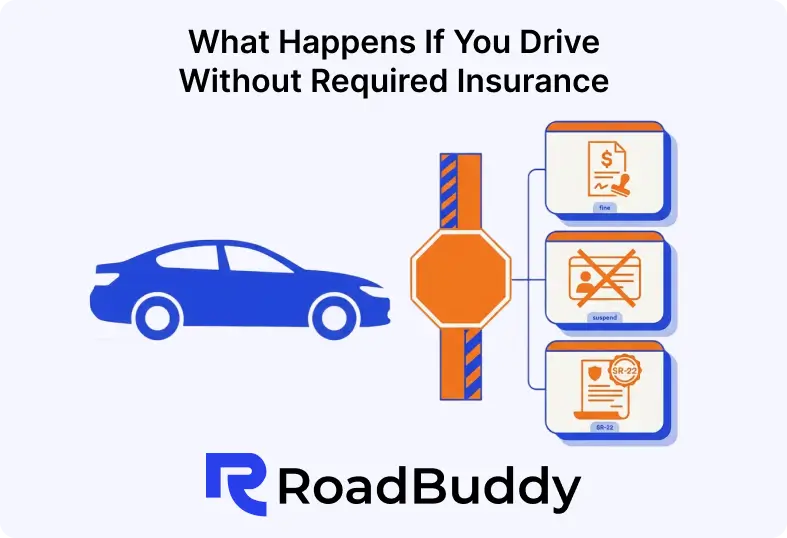
What Happens if You Don’t Have Insurance
Furthermore, driving without any insurance is illegal. The penalty for this is severe, and the penalty varies depending on the state.
If a police officer stops your car and you do not have any proof of insurance, the following will be the typical fallout options:
- Fines ranging from a few hundred dollars to $5,000 depending on the state
- Driver’s license suspension
- Vehicle impoundment (your car gets towed)
- Requirement to file an SR-22 form, which proves financial responsibility to your state for several years
In addition, if you are involved in an accident and you do not have insurance coverage, the consequences are more severe. In this case, you are held individually liable for any damages or injuries that you may have caused. This includes the cost of repairing the other person’s vehicle, medical expenses, as well as legal expenses if the other person decides to sue you.
If the accident has caused significant damage or injury, you could end up being sued. This could lead to wage garnishment or other severe financial penalties. People often underestimate the cost of medical bills or repairs to the other person’s car after an accident. The cost of repairs could end up being more than $100,000.
Apart from the legal penalties, driving without insurance could lead to higher insurance rates. When you apply for insurance after being caught driving without it, the company could perform a background check on you. They could then charge you higher rates or even refuse to give you a policy.
Is the Minimum Requirement Actually Enough?
The difference is this: What your state may require of you may differ from what experts recommend. Most states have minimum requirements that are relatively low. In most cases, this includes $25,000 per person for bodily injury. However, this amount can quickly disappear when you have to cover hospital bills for someone you have accidentally injured.
Experts recommend that you have between $100,000 to $300,000 worth of liability coverage. This amount varies according to your assets and income. The general rule of thumb is to have liability coverage equal to your net worth. This is the total of your assets minus your liabilities.
If you have assets of any size, you’re taking a risk by having the bare minimum. If you get sued for damages that exceed your coverage, you could lose your home or have your wages garnished.
On the other hand, someone with few assets and minimal income might reasonably carry state minimums because there’s not much to sue for beyond what insurance covers anyway.
Specialized Requirements
Some situations trigger additional insurance requirements:
- If you have a suspended license or have driven without insurance, your state will require you to submit an SR-22 form to your DMV. This form will prove to your state that you have insurance, and you will be required to keep it on file for a certain period of time – typically 3 to 5 years, depending on the nature of your crime.
- If you are financing a vehicle, your lender will require you to have collision and comprehensive coverage in addition to liability coverage, even if your state of residence doesn’t require it. This is because the lender has a vested interest in protecting their investment in the vehicle.
- If you are driving someone else’s vehicle, you may be covered under their insurance policy if they have permissive use coverage, but it’s better to check before driving than after an accident.
Make Sure You’re Not Overpaying
You’ll be redirected to our partner’s site to get offers.
Advertiser Disclosure
RoadBuddy is a free resource that helps drivers compare auto insurance options.
We may receive compensation from some insurance companies and partners when you click on links or request a quote through our site. This may affect where offers appear, but it does not influence our reviews, guidance, or editorial decisions.
Our content is researched and written independently to give you clear and unbiased information.
By using RoadBuddy, you acknowledge and accept this disclosure. Learn more.
Checking Your State’s Specific Requirements
The requirements for your state will be listed on your state’s Department of Motor Vehicles website. However, the overall framework will be the same for the majority of the country. The easiest thing to do is call your insurance company and ask them directly if your current insurance will meet the requirements of your state. They will be able to give you an immediate answer and make recommendations for changes if needed.
If you’re in the process of purchasing an insurance policy, then at least making sure you have the minimum required by your state is a good idea before deciding whether or not you want to purchase additional insurance. It’s common for people to purchase additional insurance, such as collision and comprehensive, in addition to the minimum required by your state. The minimum required is the legal minimum. It’s not necessarily the amount of insurance that you need. However, at least knowing what your state requires will be a good starting point for making an informed decision.
Table of contents

Looking for Auto Insuranse?
Make sure you’re not overpaying
You’ll be redirected to our partner’s website to compare personalized offers.
Advertiser Disclosure
RoadBuddy is a free resource that helps drivers compare auto insurance options.
We may receive compensation from some insurance companies and partners when you click on links or request a quote through our site. This may affect where offers appear, but it does not influence our reviews, guidance, or editorial decisions.
Our content is researched and written independently to give you clear and unbiased information.
By using RoadBuddy, you acknowledge and accept this disclosure. Learn more.