
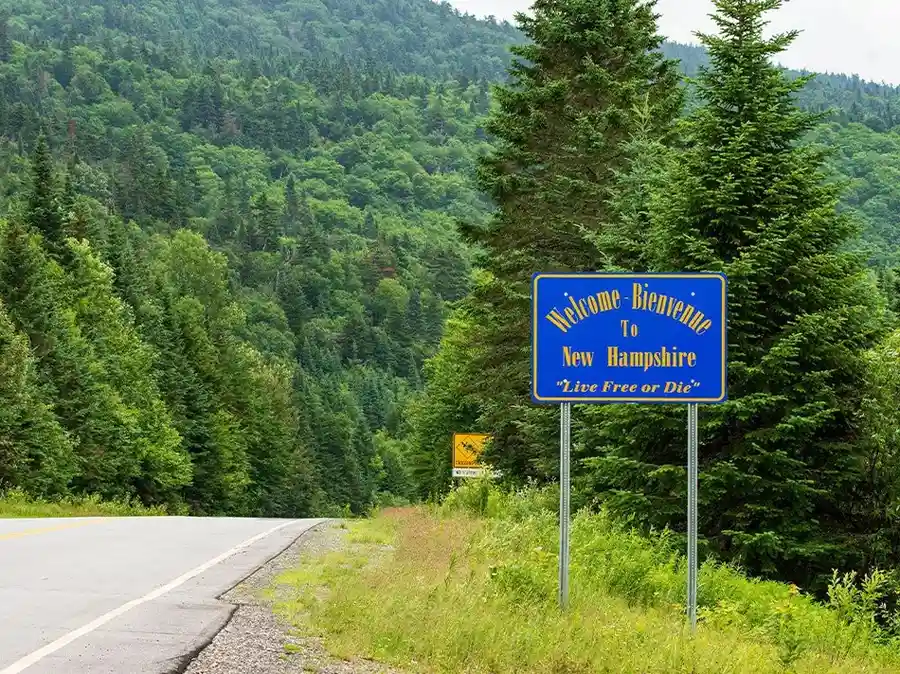
New Hampshire is the one state where drivers can legally register and operate a vehicle without carrying an auto insurance policy. That’s real. It’s also where a lot of people misunderstand what the rule actually means.
New Hampshire still expects drivers to be financially responsible for the harm they cause. If you choose to skip insurance, you’re not skipping the bill after a crash. You’re taking that bill on personally, and the state has a mechanism that can require you to prove you have the money to cover it.
The “$100,000 catch” people keep talking about
One way to prove financial responsibility in New Hampshire is to deposit money or approved securities with the state treasurer and provide a receipt as proof. The statute allows using a deposit as proof of financial responsibility. In popular summaries of New Hampshire’s setup, that “proof” amount is commonly described as $100,000 per vehicle, which is why you’ll see the “$100,000 catch” headline.
Two clarifications matter here:
First, most people do not do this. They just buy insurance because tying up that much cash (or equivalent securities) is not realistic for most households.
Second, the legal language is about proving you can meet the required coverage amounts under New Hampshire’s financial responsibility framework, and the deposit route is one method.
“Optional insurance” doesn’t protect you from lenders or the DMV
Even in New Hampshire, you can still end up effectively required to carry insurance for practical reasons.
If you finance or lease your vehicle, the lender typically requires full coverage (collision and comprehensive plus liability) because they’re protecting their collateral. That’s not New Hampshire being strict. That’s your contract with the lender.
Separately, drivers with serious violations or certain enforcement actions can be required to file an SR-22, which is proof of financial responsibility filed by an insurer. Once you’re in SR-22 territory, you’re no longer in the “I’ll just skip insurance” world.
Make Sure You’re Not Overpaying
Advertiser Disclosure
RoadBuddy is a free resource that helps drivers compare auto insurance options.
We may receive compensation from some insurance companies and partners when you click on links or request a quote through our site. This may affect where offers appear, but it does not influence our reviews, guidance, or editorial decisions.
Our content is researched and written independently to give you clear and unbiased information.
By using RoadBuddy, you acknowledge and accept this disclosure. Learn more.

What this looks like in real life after a crash
Here’s the part that gets ignored in the “Live Free” version of the story: when you cause a crash without insurance, you don’t get a friendly invoice. You get direct liability exposure.
That can mean paying for the other driver’s medical bills, lost wages, and property damage out of pocket. If you can’t, it can turn into lawsuits, wage garnishment, liens, and long-term financial damage. Insurance exists to transfer that risk away from your personal assets. Skipping it means you keep the risk.
New Hampshire’s framework is basically saying: you can choose to self-insure, but you don’t get to be judgment-proof.
Why most drivers still carry a policy anyway
Even if you have savings, insurance still solves a few problems that “I’ll pay if something happens” doesn’t solve well.
Insurance provides legal defense, which is a major cost in serious crashes. It also provides structured claim handling, which matters when medical treatment, repair negotiations, and liability disputes get messy. And it protects you from the kind of large, unpredictable losses that are hard to budget for even if you’re financially stable.
So yes, New Hampshire is unique. The “no required insurance” part is accurate. The more accurate framing is: New Hampshire gives you a choice between buying an insurance policy and proving (and bearing) financial responsibility yourself. For most people, the insurance policy is still the practical choice.