
Holiday weekends mean more drunk drivers are on the road at the same time there’s already more traffic. You have late-night driving, unfamiliar roads, people leaving parties at the same time, and sometimes inclement weather. It’s a combination of factors that make Thanksgiving weekend, Christmas and New Year’s, St. Patrick’s Day, and July 4th times when DUI arrests and alcohol-related accidents are higher than an average day.
What “DUI” means in the US, and why one drink can still matter
In every state, the common “per se” legal threshold for adult drivers is a blood alcohol concentration (BAC) of 0.08 g/dL. That’s the level where the law treats you as impaired regardless of whether you feel “fine.” The risk starts earlier than that, and the effect isn’t only about feeling drunk. Alcohol reduces reaction time, attention, and the ability to process multiple things at once, which is exactly what driving requires.
BAC is also not a universal “drink count.” It varies based on body size, sex, how quickly you drink, food intake, and metabolism. That’s why people can reach impairment after fewer drinks than they expect, especially during long holiday gatherings where drinks are spread out and people lose track.
How BAC changes driving ability
Here’s a practical way to understand what changes at each BAC level. Even the lowest range has measurable effects on attention and visual tracking.
| Blood Alcohol Concentration in g/dL | Predictable Effects on Driving |
|---|---|
| 0,02 | Decline in visual functions (rapid tracking of a moving target) and the ability to perform two tasks at the same time (divided attention) |
| 0,05 | Reduced coordination, reduced ability to track moving objects, difficulty steering and reduced response to emergency driving situations |
| 0,08 | Impaired concentration, short-term memory loss, weakened speed control, reduced information processing capability (e.g., signal detection, visual search) and impaired perception |
| 0,1 | Reduced ability to maintain lane position and brake appropriately |
| 0,15 | Substantial impairment in vehicle control, attention to driving task, and necessary visual and auditory information processing |
Why holiday DUI risk is higher than a random Saturday
Holiday driving risk climbs for reasons that have nothing to do with any one driver’s intentions. People drive later than usual. Roads are busier. A lot of trips start and end in residential areas where visibility is lower. Drivers may be tired, distracted, or rushing between gatherings. When alcohol is added, the margin for error becomes small.
This is also why December is consistently one of the tougher months for alcohol-related crash outcomes. More gatherings and more travel create more opportunities for someone to make a poor decision late in the night.
How High-Risk and DUI Drivers Can Still Reduce Car Insurance Costs
The expensive part of a DUI is not only the fine
A DUI can start a whole list of expenses that can add up. Some are immediate, such as towing, impound charges, court costs, or bail. Others can go on for months or years, such as probation charges, classes, license reinstatement, or alternative transportation if your license is revoked.
Legal counsel is another area where the expense can vary greatly. This depends on the state, the circumstances, and whether there are any aggravating circumstances (high blood alcohol level, accident, injuries, refusal, minors in the vehicle). Another area that many DUI offenders must consider is ignition interlock devices.
And then there’s insurance. A DUI is one of the most heavily penalized offenses against a driving record. This can cause insurance rates to increase substantially, as well as limit the ability of a driver to be insured through traditional means and force them into non-standard markets where the rates may be even worse.
When you add it all up, a single DUI can realistically cost a driver as much as five figures out of pocket.
How to get home safely, in ways people actually use
The best plans are those that involve the fewest decisions to be made at the end of the night. If the plan involves “I’ll see how I feel,” it’s not really a plan.
The designated driver works well if the commitment is made beforehand and the driver does not drink any alcohol. Calling a friend or family member can work well, especially if you set this up beforehand. Rideshare or taxi can work well, as it eliminates the need to make a decision about driving altogether.
If you drove to a party and don’t want to leave your car, AAA’s Tow-to-Go is an option some states offer during certain holiday periods. This can give you a ride home and tow your car a short distance. Just be sure to check if this service is available before you need it, not after.
Make Sure You’re Not Overpaying
Advertiser Disclosure
RoadBuddy is a free resource that helps drivers compare auto insurance options.
We may receive compensation from some insurance companies and partners when you click on links or request a quote through our site. This may affect where offers appear, but it does not influence our reviews, guidance, or editorial decisions.
Our content is researched and written independently to give you clear and unbiased information.
By using RoadBuddy, you acknowledge and accept this disclosure. Learn more.

Hosts have responsibilities too, and liability can get complicated
If you’re hosting and serving alcohol, your job is not only hospitality. It’s also risk management. A host cannot control every choice a guest makes, but a host can reduce the odds that someone leaves impaired and then claims “nobody stopped me.”
Simple actions go further than one might think. Provide food throughout the event, not just at the start. Provide water and non-alcoholic drinks in plain sight and easily accessible. Slow service towards the end of the night, especially if guests are lingering and drinking becomes less structured. If possible, post ride options in a spot where people will notice them: a note by the door, a QR code for rideshare, or a reminder in a group text.
Consider pacing, especially with mixed drinks and shots. Guests tend to underestimate the amount of alcohol in a given drink and overestimate how quickly they can “burn it off.” If a guest seems intoxicated, intervene early rather than waiting until they are holding car keys. Offer to call a ride, offer to let them stay, and if necessary, take the keys. If you are not comfortable doing this alone, ask another guest you trust and make it a joint decision.
There is also a legal and insurance angle that many hosts ignore. Homeowners insurance can have exclusions, and liability exposure depends on your state’s rules and your policy language. “Social host” laws vary by state, and some situations create legal risk when alcohol is served and an impaired guest later causes harm. Even when a host ultimately is not held responsible, dealing with the aftermath can be expensive and stressful. Anyone who hosts regularly should know what their homeowners liability coverage includes and what it excludes.
The simplest way to avoid the entire problem
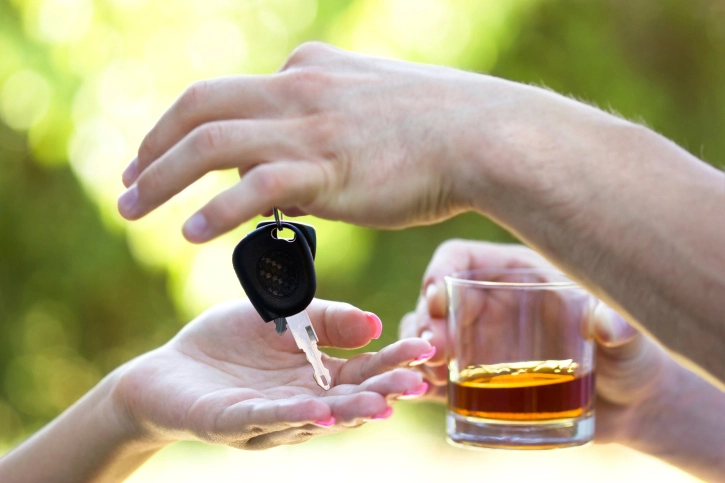
Make the ride home decision before the first drink. This one decision avoids most of the consequences that people later look back on and say “that was a mistake.” If you plan to drink, make arrangements for a ride home in advance, designate a driver, or plan to stay where you are. If you drove to a party, consider leaving your car overnight a normal occurrence rather than a failure.
It is also helpful to plan for the times that lead to poor decisions. People leave holiday parties in droves, often late, and often when they are tired. Rideshare wait times can skyrocket. The weather can turn on a dime. The best way to avoid last-minute planning is to have a plan B. This can be a second person you can call, money set aside for a taxi, a nearby place to sleep, or a host who has already agreed that guests can stay if they need to.
If you are a guest, be mindful of the group, not just yourself. If someone says they are fine, ask them how they are getting home and offer an alternative solution. If you are the host, make safe departure an integral part of the event, not something to be worried about afterwards. The result could be police calls, injuries, or years of financial damage.
The surefire way to ensure safe driving after drinking is to abstain from drinking at all if you have to drive afterwards. For some people, this means abstaining at any event where they drove themselves to the party or opting for zero-proof drinks by default. If there’s no alcohol in your system, there’s no guessing, no counting drinks, or any last-minute decision about whether you are fine or not.